

Google Asks for a Human in the Loop, AI Overviews Reach Branded Searches, and Meta Opens Muse to Small Business
 ChatGPT
 Claude
 AI Mode
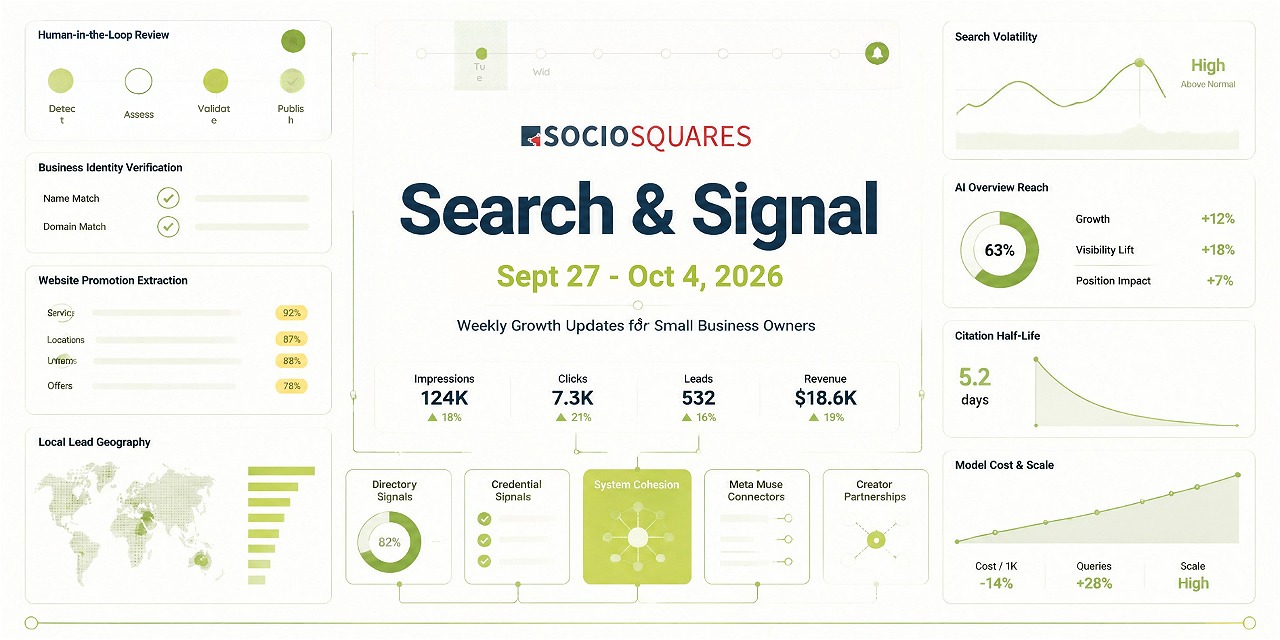
Here is what changed this week for local service businesses and law firms, with a plain note on what to do about each one. Google AI Overviews are appearing more frequently for branded searches, making AI search visibility an increasingly important part of how businesses are discovered online.
Google Ads and Local Services Ads
Google Ads is loosening its business name rules, starting October 16. Until now, the business name on an ad had to line up with the domain it pointed to. Under the updated policy, some advertisers can use a name that differs from their domain, as long as the name accurately reflects the recognized name or brand of the advertiser. Google also asks for a verified direct relationship between the advertiser and the domain owner and for the advertiser’s products or services to be offered directly on the destination domain. Third-party resellers, independent booking intermediaries, and affiliate distributors are excluded, according to Search Engine Land’s report on the policy.
For a local business, the situations that may fit are a firm or contractor whose public name and website address have never matched. A law firm named for its founding partners that runs on a shorter domain is one example. A home service company that rebranded but kept its older web address is another. If that sounds like you, the next step is simple: confirm your advertiser verification is current before October 16 so the option is open to you if you qualify.
Google Ads will start pulling promotions from your website on October 12. Search and Performance Max campaigns that have linked location assets but no promotion assets will be eligible. Google scans the advertiser’s site for valid, high-quality promotions and turns them into promotion assets that show up in the Assets section of the account. It is on by default, and advertisers can switch it off at the account level in the automated asset settings, per Search Engine Land.
This one can work in your favor. A “$89 tune-up” or “free estimate on repairs over $500” banner on your homepage could become a promotion asset without any extra setup. The flip side is housekeeping: an expired spring special still sitting on a page could get picked up. Before October 12, scan your site for old offers, then decide whether you want to keep the automation on.
Local services ads targeting is drawing questions in California. Search Engine Roundtable reported that Local Services Ads in the Fresno area were showing firms from New Jersey and Arizona that had not selected those locations. Google’s AdsLiaison account responded on October 2 that the behavior was “working as intended,” explaining that the results included firms that serve customers seeking that type of legal service in the Fresno area. Advertisers who see leads from cities outside their service area now have a reason to check their lead reports.
A fifteen-minute review covers it. Pull the last 30 days of leads, sort by city, and compare against the service areas you selected. If calls are arriving from places you do not serve, use the lead feedback options in your account and note the dates so your Google contact has specifics.
SEO and Search Console
The September spam update picked up a second wave on September 30. Google said the update would take around two weeks to roll out, and Search Engine Roundtable tracked a distinct shift on September 30 and October 1 after the first wave on September 25 to 27. Glenn Gabe wrote that he saw a specific change on September 30 and heard from several site owners about large drops that same day. Volatility trackers, including Mozcast and Semrush, confirmed movement on both impact dates.
With the rollout expected to wrap up in the coming days, the sensible plan is to hold steady until Google marks the update complete, then compare your week-over-week data in Search Console. Changing titles, pages, or links mid-rollout makes it hard to tell what moved the numbers.
Google gave real numbers for how long search changes take to show up. At Search Central Live in Barcelona on October 2, Gary Illyes shared typical timing ranges, summarized by Search Engine Journal. A new URL is typically discovered in about 20 hours. A known URL gets refreshed roughly every 30 days. Title and snippet changes usually show up in one to two days. Site moves take one to three months, and recovery from a core update typically takes three to six months. Google did not share sample sizes, so treat the figures as reference points.
If you updated your Google Business Profile website link, changed a page title, or redirected an old service page, these ranges give you a calendar to measure against. A title tweak should be judged after a few days. A site move deserves a quarter.
AI Search and Visibility
AI Overviews now appear for 83% of branded searches in Ahrefs’ data. Ahrefs analyzed 232.8 million US desktop Google results from July through September. As of September 29, AI Overviews appeared in 82.91% of branded keyword results. The monthly average climbed from 61.3% in July to 65.1% in August to 73.3% in September. The most cited sources in those branded overviews were Wikipedia (71.9%), YouTube (38.6%), and LinkedIn (22.8%).
A note on scope: the data is US desktop only, and the report’s separate panel of 100 major brands came from Interbrand’s Best Global Brands list. It does not address small businesses specifically, so your results may differ. The direction is clear, and the takeaway is a concrete one. Search your own firm or company name on Google and read the AI overview if one appears. Check whether the details are right: your services, your city, your phone number, and your practice areas. LinkedIn and YouTube both ranked among the most cited sources, and both are profiles you control, so they are good first places to tidy up.
A typical page loses half its AI citation share within 11 days of peaking. Profound, an AI visibility platform, tracked 883,000 pages across seven AI search engines between September 2025 and September 2026, covering 1.19 million pages and engine lifecycles. Its finding is that the median page loses half its citation share within 11 days of its peak. Some patterns in the data are useful for planning:
- News and announcements fade fastest, while comparison pages and guides last longer. Reporting content was 1.4 to 1.6 times more likely to fade than evergreen formats.
- Pages cited by five or more engines were 5.5 times more likely to keep their visibility beyond eight weeks.
- Claude citations were the most durable. Pages that sustained there were 2.8 times more likely than ChatGPT pages to retain half their peak share after eight weeks.
- Citation patterns across engines barely correlated (0.03 to 0.09), so each engine behaves like its own channel.
Profound sells tracking tools, so read the study as one vendor’s dataset. The planning idea holds up on its own, though. A page that answers “how much does a water heater replacement cost in [city]” or “what happens after a car accident claim is filed” can keep earning citations, while a post about this week’s news will have a short run. Putting your best evergreen pages on a refresh calendar, say every quarter, is a low-effort way to stay in the mix.
For law firms, AI assistants point to directories and state bars before they point to individual firms. Zen Media released a benchmark on October 1 built on 1,000 legal consumer prompts run through ChatGPT, Gemini, Perplexity, and Grok, producing 4,000 responses. No individual law firm appeared in the top 20 most visible names across the four platforms. Avvo led at 45% visibility, followed by Martindale-Hubbell at 32% and Super Lawyers at 24%. Directories and rating platforms made up 45% of all company mentions, and state bar associations were cited in 92% of sourced answers. Credential verification showed up in 92% of responses, specialization in 87%, and fee transparency in 85%.
This is a press release from a single company, with a sample of 1,000 prompts, so treat it as directional. The direction is encouraging for firms of every size, because it points to inexpensive, controllable work: complete and accurate profiles on the directories. AI assistants lean on a current state bar listing, clear statements of specialization, and plain language about how fees work, including contingency arrangements. A firm that publishes those details on its own site gives the assistants something to quote.
Keep your name, services, and listings consistent as your business changes. Semrush described what it calls the LLM positioning lag: AI tools keep repeating a company’s old positioning after the business has moved on. It points to Hotjar, which AI answers still describe as independent even though Contentsquare acquired it in 2021. Semrush lists three causes: outdated training data, conflicting descriptions across sites and profiles, and years of older content outweighing recent changes. Its fixes include updating legacy pages, keeping business listings current everywhere, and checking regularly what AI tools say about your brand.
For a local business, the translation is direct. If you added a practice area, opened a second office, changed your firm name after a partner joined, or started offering emergency service, spend an afternoon updating your website, Google Business Profile, directory listings, and social bios with the same wording. Consistency is the signal that tells these systems which version is current.
Website and Content for AI
Google now says it is critical to manually fact-check AI-generated content. The page on using generative AI content, updated October 1, states: “It is critical to manually fact-check and review all AI-generated content for accuracy and trustworthiness before publishing.” The guidance extends beyond body copy to title tags, meta descriptions, structured data, and image alt text. Google’s explanation is that generative models predict likely word sequences rather than retrieve facts, which can produce inaccuracies.
Google also added a warning about fake authors. In its people-first content guidance, also updated October 1, Google says that fabricating creator profiles, such as using AI-generated headshots, made-up names, or false credentials to make content appear to be written by human experts, is a form of deception. It adds that any form of deception makes a page untrustworthy to users and to Google’s automated quality systems.
For firms and contractors, this is good news for anyone who already publishes under real names. Attorney bios with real photos, bar numbers, and practice histories are exactly what the guidance rewards. A contractor’s “About” page with the owner’s actual face and license details does the same job. If any old blog posts carry a stock-photo author or a placeholder name, replace them with the real person who reviewed the piece.
AI is now part of most content workflows, and review is where quality gets decided. Ahrefs surveyed 301 marketers for its new research report. Ninety-three percent use AI for content creation, and 69% are publishing a larger share of AI-assisted content than last year. Two-thirds (66%) trust AI output only after a human has reviewed it, while 2.7% accept it without any review. Eighty-five percent say they produce content faster with AI, yet 56% of AI users still believe human-written content is better than what AI produces for them. Seventy-eight percent do not disclose their AI use to site visitors.
The picture that comes out of the survey and Google’s updated guidance is consistent. Speed from AI is real, and the accountable step is the human check before publishing. For a law firm, that check belongs with an attorney who knows the subject. For a trade business, it belongs with the owner or lead technician who knows the real prices, service areas, and timelines. A short checklist helps: confirm every number, every date, every legal reference, and every service claim against a source you can name.
Key takeaway: Pair AI drafting with a named reviewer and a visible author on every page. Google’s October updates, the Ahrefs survey, and the way AI assistants cite credentials all point the same way.
Meta opened Muse to small businesses on September 29. Muse is Meta’s personal AI agent, introduced on September 8, and the small business version connects to Facebook and Instagram analytics and Meta ad accounts, plus tools such as Shopify, Stripe, QuickBooks, Canva, Slack, Zoom, Notion, Figma, and Dropbox. Owners can also build custom connectors for tools that are not on the list. According to The Next Web, the agent will not post content, send messages, or buy anything without the owner’s approval. Most users get Muse at no cost, with paid plans offering higher usage limits, and Meta has not announced separate pricing for the business version. Adweek reported that the launch targets the roughly 200 million brands that operate on Meta’s platforms.
A reasonable first step is a read-only task. Connect your ad account and ask for a plain summary of last month’s spend, cost per lead, and top-performing creative, then compare the answer against what you see in Ads Manager. If the numbers match, you have a time saver. If they do not, you have learned something about how much to trust it before giving it more responsibility.
Instagram livestreams can now run as partnership ads. Starting September 29, brands can run a creator’s Instagram livestream as a partnership ad. Meta’s Creator Marketing Hub, now global, includes built-in messaging so brands can talk with creators directly and one-click ad creation. The live format previously existed on Facebook and has now reached Instagram.
For local service businesses, the natural fit is community content: a local home and garden show, a neighborhood event you sponsor, or a creator who tours a finished remodel. Law firms should check advertising rules in their state before using creator partnerships, since attorney advertising carries its own requirements.
AI Models and Cost
Google announced Gemini 4 Argon with a lower price tag. The September 30 announcement describes a model with a 1 million token output limit, up from 64,000, aimed at software engineering, enterprise knowledge work such as legal and finance, and cybersecurity defense. Introductory pricing is $2 per million input tokens and $10 per million output tokens, with a 95% discount on cached input tokens. Standard pricing of $4 and $20 applies after the introductory period.
Access is limited for now. Google is rolling it out first to a set of trusted cyber defenders through its Fairwind Program and says it will reach developers, enterprises, and consumers as soon as possible, starting with paid API customers and Google AI Ultra subscribers. Yahoo Finance reported that there is no public release date, that the pricing comes in at about half the cost of some rival models, and that Argon trails OpenAI and Anthropic on two of the four coding tests Google included.
A small business does not need to pick a model. What matters is the trend: competition on price tends to flow through to the tools you already pay for, whether that is a chatbot on your website, an intake assistant, or a content tool. When renewal time comes, ask your vendors what they are paying per task and whether savings are passed along.
Prompt of the Week
Google’s October guidance asks for a manual fact-check of AI-assisted pages. This prompt turns that step into a quick, repeatable review. Paste it into your AI assistant of choice, then add the draft below it.
You are a careful fact-checker for a [law firm / HVAC company / plumbing company] website in [city, state]. Below is a draft page.

1. List every factual claim in a table with these columns: claim, where it appears, what source would confirm it, and risk if wrong (high, medium, or low).
2. Include numbers, dates, prices, laws or regulations, licenses and credentials, service areas, timelines, and any "best" or "only" statements.
3. Do not confirm any claim yourself. Mark each one "needs a human to verify."
4. Then list any sentence that sounds specific but names no source, and suggest what to ask the subject expert.

Draft:
[paste page text, including title tag and meta description]

